Anúncios
If a single plant deserves its own beginner’s guide, it’s the pothos. There’s a reason it’s the most-recommended first houseplant on earth: it survives almost everything. Forgetful waterers. Dim corners. Erratic temperatures. Apartments without windows. It droops dramatically when thirsty, perks up within hours of being watered, and keeps growing through it all.
This guide covers everything you need to keep one alive and looking good – and a few things that will make it actively thrive.
Anúncios
What you’re working with
Pothos (botanical name Epipremnum aureum, sometimes still sold as Scindapsus aureus) is a trailing vine native to the South Pacific. In its natural habitat it climbs up trees and produces leaves the size of dinner plates. Indoors, in a pot, it stays smaller and gentler – heart-shaped leaves on long trailing stems that spill beautifully off a shelf or hang from a planter.
The most common variety is “golden pothos” – green leaves with yellow marbling. You’ll also see:
- Marble queen: cream and green variegation, prefers a bit more light.
- Neon pothos: almost yellow-green, smaller leaves.
- Pearls and jade: small leaves with white edges.
- N’joy: compact, very heavily variegated.
Care is roughly identical across varieties – the more variegated ones (lots of cream or white) need a bit more light to keep their colour.
Anúncios
Light: not as fussy as people think
Pothos tolerates a huge range. From bright indirect light all the way down to dim corners. It grows much faster in brighter spots and more slowly in darker ones, but it stays alive in conditions that kill most other houseplants.
What it doesn’t like: direct, blazing sun. A few hours of morning sun is fine; full afternoon sun through a south-facing window can scorch the leaves. If your only sunny spot is intense, put the plant a few feet back from the window or behind a sheer curtain.
For more on matching plants to your actual light conditions, see our guide to plant sunlight needs.
Watering: the only place beginners go wrong
This is where people kill the unkillable plant. The instinct is to water on schedule. Pothos hates that. It wants:
- The top inch of soil to dry out between waterings.
- A deep watering when it’s time – water until it runs out the drainage holes.
- The saucer emptied so the pot isn’t sitting in water.
In practice that’s usually:
- Every 7-10 days in bright light, summer.
- Every 12-18 days in low light or winter.
- Less if the pot is large; more if the pot is small.
Always check the soil first. Push a finger in. Dry? Water. Damp? Wait.
Soil and pot
Any standard potting mix works. Don’t overthink it. The pot needs drainage holes – that’s the only non-negotiable. A 6-8 inch pot is fine for a small starter plant; size up to 10-12 inches as it grows.
Pothos doesn’t like pots that are way too big. Excess soil holds water the roots can’t use, which encourages rot. When repotting, go up one or two pot sizes, not five. For the full breakdown on why pot size matters, see potting soil vs garden soil.
Humidity and temperature
Pothos is a tropical plant that nonetheless tolerates regular indoor air just fine. It does not need a humidifier, misting, or a humidity tray. It is one of the most low-maintenance plants in this regard.
It does dislike cold. Below 50°F (10°C) it sulks; below 40°F (4°C) the leaves can blacken. Don’t put it on a windowsill that gets a cold draft in winter.
Pruning: do it more often than you think
Pothos vines get long. Without pruning, they become a few stems trailing 6-8 feet down with bare upper sections. With occasional pruning, you can keep the plant full and bushy.
The rule: snip just above a leaf node (the little bump where a leaf joins the stem). New growth will sprout from that node. You can prune any time of year, but spring and summer give the fastest regrowth.
Don’t be shy. A pothos that’s been pruned hard fills back in within a few months. And the cuttings root easily in water – more on that next.
Propagation: free plants forever
Pothos is one of the easiest plants to propagate. From a single mother plant you can have a dozen new pothos plants within a few months.
- Take a cutting with at least one leaf and one or two visible nodes (the small brown bumps on the stem).
- Put the cutting in a glass of water with the node submerged, leaf above water.
- Place somewhere with bright indirect light.
- Change the water every week.
- In 2-3 weeks you’ll see white roots emerging from the node.
- When roots are an inch or two long, plant in a small pot of potting mix.
That’s it. The success rate is close to 100% if the cutting has a node.
Common problems and what to do
| What you see | Cause | Fix |
|---|---|---|
| Yellow leaves, soft | Overwatering | Let soil dry out more; check drainage |
| Yellow leaves, dry crispy | Underwatering or dry air | Water more thoroughly |
| Brown leaf tips | Underwatering or tap water minerals | Water more deeply; let tap water sit overnight before using |
| Pale, washed-out leaves | Too much direct sun | Move further from window |
| Losing variegation (going more green) | Not enough light | Move closer to a window |
| Leggy stems with sparse leaves | Not enough light or no pruning | Brighter spot, regular pruning to encourage branching |
| Black mushy stems | Root rot | Take healthy cuttings; the rest of the plant may not recover |
| Tiny black flies around the soil | Fungus gnats from over-wet soil | Let soil dry between waterings; yellow sticky traps |
For the broader list of beginner mistakes that apply to most houseplants, see our 15 beginner gardening mistakes guide.
When and how to repot
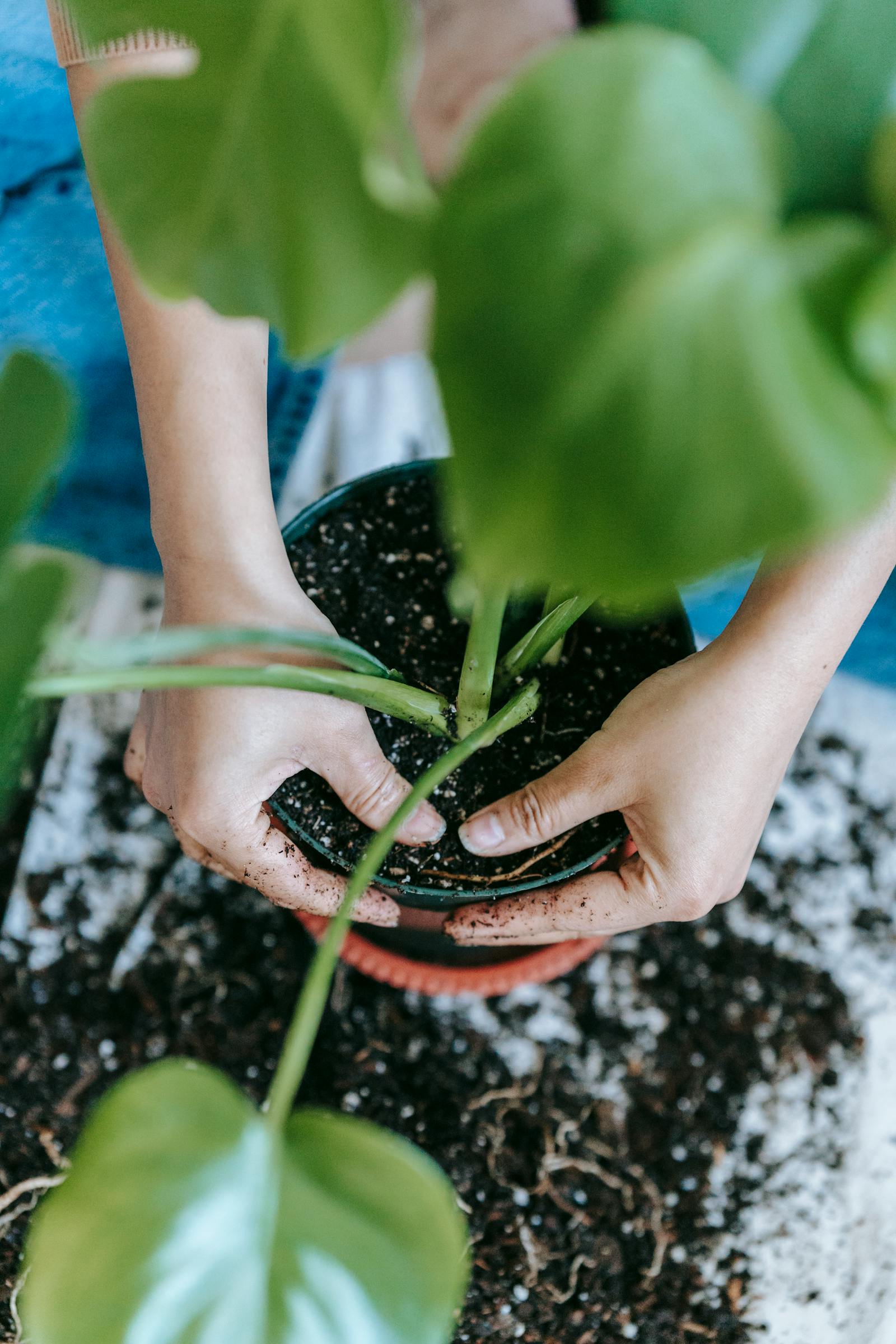
Repot when roots start coming out the drainage holes, or when the plant is drying out too fast (water disappears within 1-2 days). Most pothos need repotting every 1-2 years.
- Pick a pot one or two inches larger in diameter than the current one.
- Loosen the plant out by squeezing the sides of the pot and tipping it sideways.
- If roots are tightly circled, gently loosen them with your fingers.
- Place in the new pot with fresh potting mix – the top of the root ball should be about an inch below the rim.
- Water thoroughly and put back in its usual spot.
Don’t fertilize for the first month after repotting – the fresh soil has enough nutrients.
Pet safety
Worth flagging: pothos is mildly toxic to cats and dogs if chewed. It causes mouth irritation and sometimes vomiting, rarely serious but uncomfortable. If you have a curious pet, hang the plant high or keep it in a room the animals can’t access. The low-light indoor plants list includes pet-safe alternatives like spider plants and parlor palms.
How long will it live?
Indoors, with reasonable care, a pothos can live for 10+ years. The mother plant keeps growing while you propagate cuttings to share or repot. There are pothos plants in offices that have been alive for decades, traded between coworkers, occasionally relocated, still going.
The short version
If you remember three things: water when the top inch is dry, not on schedule. Pot with drainage holes. Prune occasionally. That’s the whole care guide. Light is forgiving. Humidity is fine indoors. Soil isn’t fussy. It really is the easiest serious houseplant you can own – and one of the most rewarding, because it grows quickly enough to make you feel competent.
If you want more plants like this, our best low-light indoor plants roundup covers other beginner champions that thrive in similar conditions. And if you’re managing watering issues across multiple plants, how often to water plants is the next step in the system.